Who “deserves” a heart transplant? How do we make sense of a cerebral hemorrhage that hits an otherwise healthy young woman out of the blue? What’s it like to live with a terminal diagnosis? What can we learn from our bodies that words and conventional images alone can’t tell us? How do healthcare providers who are trained to keep their emotions in check hold on to their humanity? The answers are seldom straightforward and are often frustratingly inconclusive.
For a growing number of artists whose work falls under the umbrella of graphic medicine—and the readers who make up their audiences—words and drawings in short- or long -form works, the genre provides an effective platform for not only exploring these questions, but for understanding and education, advocacy and activism. In publications that include single frame cartoons, self-published zines or “floppies” (comic-book-style publications) as graphic memoirs and novels, the message is often both less and more complex than text alone. In a single cartoon frame portraying, for example, the relaying of a prognosis, the expression on the face of a patient, the body language of a physician, and even the choice of lettering in the thought or speech bubbles that accompany the drawing, can create an emotional impact that resonates deeply and immediately. (For some graphic medicine cartoonists, what’s left unsaid appears to be just as important as the language they include.)

Those newer to the art form, may find the Graphic Medicine Manifesto (Pennsylvania State University of Press, 2015 and 2025) a fine place to start. Authored by a group of six creators* made up of clinicians and caregivers as well as those working in the medical humanities, the volume serves as a kind of bible for the community. Co-author Ian Williams, a physician and graphic novelist, coined the term graphic medicine to describe comics and graphic novels with medical content. The field is variously described by other members of the informal collective behind the manifesto as including, but not limited to, “the intersection of the medium of comics and the discourse of healthcare”, a “movement for change that challenges the dominant methods of scholarship in health care offering a more inclusive perspective [on medicine and caregiving]” and comics that “give voice to those who are not often heard”. While a significant segment of the work produced focuses on the physical and emotional aspects of illness, medicine, and caregiving, graphic medicine also serves as a means of demystifying disease and injury, professional and lay education, and even patient advocacy.
Creators in the broader graphic medicine community frequently cite its reputation for friendliness and inclusivity; numbered among their ranks are clinicians, researchers, allied health professionals, educators, public health experts, patients, medical illustrators, and others.
A quick survey of the virtual or actual graphic medicine bookshelves reveals the seemingly inexhaustible array of subject matter, with entire sub-genres devoted to specific diseases and conditions. For those on either side of the healthcare divide – providers and patients—these documents can create a bridge to understanding.
Drawing styles employed in graphic medicine are as various as in other art forms. Political cartoonist Peter Dunlap-Scholl, for example, uses a “jangly” drawing style in My Degeneration, which depicts life with Parkinson’s and the effect the illness has had on the way he makes art. Moka Onmae’s graphic novel, Good Morning, Good Night, and See you Tomorrow, based in part on her experience as a cancer patient, adheres to many of the conventions of manga (Japanese comic books and graphic novels with distinctive visual characteristics) to great effect.

Complementing the vast body of patient narratives is an abundance of graphic medicine content that focuses on medical education and clinical practice, including memoirs specific to illnesses that were once thought to be untreatable and diagnoses/conditions that have recently emerged or been identified. Graphic medicine pioneer, MK Czerwiec’s Taking Turns, for example, describes her experience as a nurse in a Chicago hospital caring for patients on an AIDs unit, and includes oral accounts from patients, family members, and staff. The book serves as a historic document as well as a memoir. Palliative care physician Nathan A. Gray’s forthcoming graphic memoir, The Human Remains: Drawing Out Compassion in Medicine, addresses the author’s efforts to maintain his humanity through residency in a system that doesn’t always allow the time and space to do so, and his continued striving while working with patients approaching the end of life.
Use of graphic medicine in the medical school setting has also grown in recent years. Penn State physician and bioethicist Michael J. Green, was among the first group of educators to teach graphic medicine; in his case, introducing the curricula to fourth year medical students in 2009. Writing on this topic in the Graphic Medicine Manifesto, Green elaborated, “[Comics] can tell compelling stories about illness and demonstrate the complexity of medical culture. Reading comics can help students think critically about the environment in which they learn and work, and making their own comics can help students communicate more clearly and precisely.” Moreover, Green wrote, “Being challenged to tell a story by drawing pictures can be an uncomfortable and often daunting exercise…. a reminder that they (and doctors in general) seldom have all the answers or skills to solve every formidable problem that comes before them.”
The relatively recent explosion of graphic medicine comics, zines, novels and memoirs, notwithstanding, it’s worth noting that there’s also a much earlier tradition of cartooning that centered on illness, the medical profession and the public. British caricaturist James Gillray’s The Cow-Pock—or—the Wonderful Effects of the New Inoculation (1802) memorably depicts the wildly imagined consequences of inoculation against smallpox among contemporary anti-vaxxers. William Hogarth (1697-1764), who famously skewered politicians, the upwardly mobile, and the morally dissolute, did not spare physicians his merciless critique in his engravings. In A Consultation of Physicians, or The Company of Undertakers, the artist depicts a gathering of doctors led by three notorious “quacks”, including John Taylor, the “oculist” said to have performed botched eye surgeries on Handel and JS Bach. More on Hogarth and his role as a member of the board of governors and muralist at St. Bartholomew’s Hospital in London, can be found on www.drawing-blood.org, a website associated the Billy Ireland Cartoon Library & Museum at Ohio. Those wishing to go even farther down the rabbit hole on the history of medical cartoons, may be fascinated by Professor Jared Gardner’s piece on the Gumps (a long-running comic strip from 1917 to 1959) in which family members contend with the threat of the Spanish flu epidemic.
State of the Art
Among those graphic medicine creators approaching the complexity of the human body, disease, and delivery of care from a distinctive perspective, are Kriota Willberg and Gianna Paniagua. Willberg, who has worked as a dancer, massage therapist, and anatomical illustrator, and holds certificates in bioethics, medical humanities, and gerontology, is the creator of numerous pieces including the Cadaver Diaries, in which she documents her experience as a student and later as a co-teacher of a drawing class for medical students in a cadaver lab. The booklet not only offers a nuanced description of this work, but also explores how Willberg grew to view bodies in other contexts, as when she sat at her father’s bedside at the end of his life, her understanding of anatomy and physiology making his death more real. “Learning …from textbooks and models taught me perfect anatomy. Dissection taught me how a body’s anatomy can vary and survive illness,” she notes in Cadaver Diaries.
Currently a part-time adjunct professor at Parsons School of Design and an instructor for Art and Anatomy at NYU Langone, Willberg’s time as the Artist in Residence at the New York Academy of Medicine led to the creation of her comic, Silver Wire. Placing herself in the story as a character, a technique that allows her to represent the naïve and curious layperson, Willberg gets a hands-on lesson on ligatures and suturing techniques (her use of fruit as “patients” makes for some intentionally humorous moments) from her friend Mollie, a palliative care physician. Throughout this section, Willberg draws the parallel to stitching techniques used for centuries by needleworkers.
The narrative then advances to a discussion of medical knowledge acquired via unethical and sometimes deeply disturbing practices over the centuries, including experiments on servants, enslaved people, and prisoners by Galen, Paré, and Bell. Willberg’s focus on J. Marion Sims and his experimentation on enslaved women—which included surgeries performed without anesthesia—in his work on vesico-vaginal fistula, serves to illustrate how the surgical techniques and advances that benefit so many women grew out of this history. The title of the comic refers to the silver wire Sims used during surgery to reduce infection. “Because Sims findings were shared internationally, individuals of all genders in countries where there was no legacy of slavery benefited,” Willberg notes. “In fact, he probably saved the lives of some of my ancestors. I think it’s important to share this information.”
Gianna Paniagua, an artist who has been both a painter and a papercutting sculptor, and is a two-time heart transplant recipient, is making another unique contribution as a graphic medicine cartoonist and patient advocate. In both mini-comics and several pieces published in Bonus Days, a magazine by and for transplant patients, among other publications, Paniagua has documented her complicated history. After receiving an initial transplant at 14 months of age due to hypertrophic cardiomyopathy, she then required another as a young adult to address transplant coronary artery disease that developed after a period of non-compliance with her treatment.
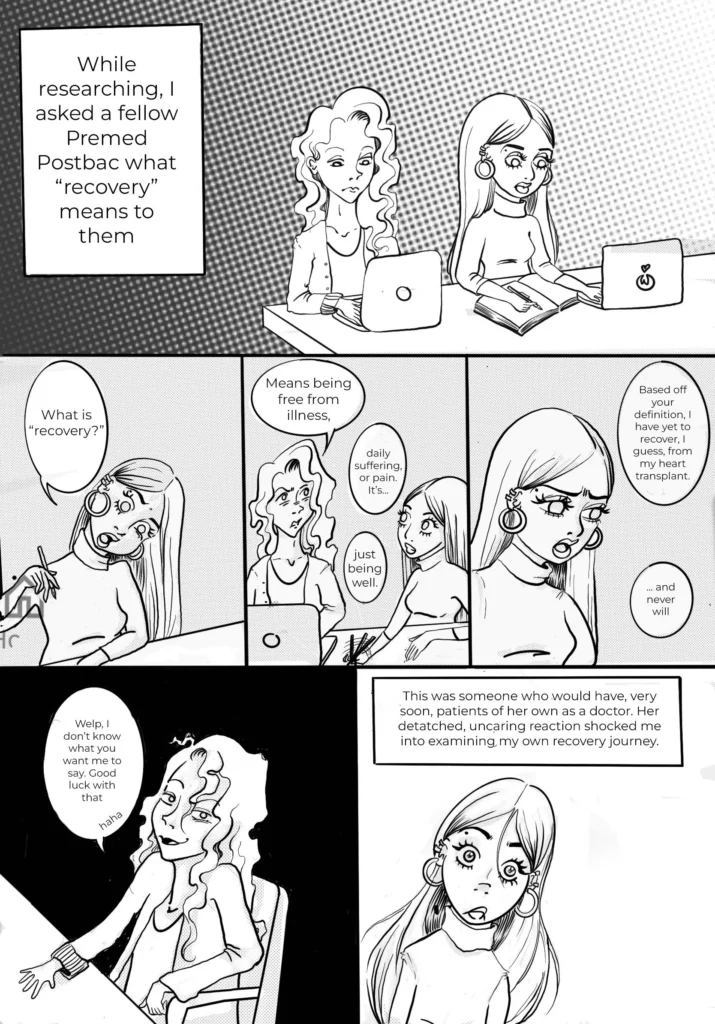
Finding an institution that would approve her for a second surgery proved challenging, and it took a great deal of perseverance to find the team at Vanderbilt University where her second transplant surgery was performed. Even with the highly supportive team in place, Paniagua says, “I thought I would die in the surgery, because it was very high risk. I was trained for years not to expect something good to happen [and] I was trying to find something where I could quickly leave a legacy and tell a story others could learn from.” Although she had focused on oil painting as an art major at the University of Pittsburgh, it was important to avoid exposure to toxins in the medium. Paper cutting was also too strenuous at the time. Graphic medicine turned out to be the natural fit for someone who had spent much of her childhood drawing. Her comic about life after surgery and the expectations of others regarding her health are powerfully shown in “Are We Ever Really Recovered?” published in Literature and Medicine in 2023.
With her second heart surgery now five years behind her, Paniagua is still immersed in the transplant world, not only as an artist, but as a patient coping with chronic pain and the demands of remaining vigilant against rejection. Her work as an advocate for other young adult heart transplant patients also takes center stage. “Dealing with the side effects of immunosuppressive drug regimens and noncompliance remain major concerns [for this population]”, Paniagua says. She also notes the importance of adequately educating female transplant recipients about issues specifically related to gender, including the impact of their condition on childbearing.
“I think there are creative solutions for this. It’s important to hear true stories about other transplant patients. It’s a way of feeling less isolated. Graphic medicine breaks barriers of education and language,” Paniagua adds. “If you see an image, it can cling to you. There’s a magic in it.”
Her commitment to helping clinicians communicate clearly and empathetically to those in their care is another driving force behind her comics. When possible, she attends conferences and participates on panel discussions on graphic medicine as well as on care for young heart transplant patients.
Paniagua also acknowledges the role of graphic medicine comics in helping her process a lifetime spent in the medical world. While enrolled at Columbia University in the Narrative Medicine program, Paniagua conceived of a capstone project depicting a heart transplant surgery for a Medical Education comic that would benefit other young transplant patients. Already in the process of founding a support group for this population, she had maintained a connection to her own transplant team and with strict adherence to HIPAA guidelines she was granted permission to be present during a transplant surgery. Although one of her advisors had expressed some reservations, thinking that Paniagua might be unsettled by the experience, she was amazed and inspired and plans to co-create more work in the future with other transplant recipients. She is also deeply gratified to know that the patient whose surgery she observed is doing well.

Owing in great part to the efforts of Graphic Medicine International Collective (www.graphicmedicine.org), comic artists like Willberg and Paniagua, among numerous others, continue to receive exposure and opportunities to network with their peers in cities around the world, both through the organization’s conferences and on their website. The widely attended Comic-Con in California has also hosted programs in graphic medicine, bringing awareness to mainstream comics audiences, while smaller conferences hosted by universities and professional societies are proliferating.
As many in the graphic medicine community will acknowledge, there is still resistance to the value of the genre in some quarters. But this, too, appears to be changing, as demonstrated by the online exhibition maintained by the National Library of Medicine: Graphic Medicine: Ill-Conceived and Well Drawn! With the imprimatur of the National Institutes of Health lending support for graphic medicine – and a growing number of published titles by physicians and other healthcare professionals receiving glowing reviews, there’s surely more widespread acceptance to come.
Selected Notes and Resources
The book alluded to in the beginning of this article is Memento Mori by Tiitu Takalo, which chronicles the artist’s recovery from a ruptured cerebral aneurysm, its effect on her life as an artist and on her personal relationships. In her introduction she also notes that citizens in her home country of Finland are spared the added burden of medical debt as they recover from a serious medical event.
The Graphic Medicine Manifesto was authored by M.K. Czerwiec, Ian Williams, Susan Merrill Squier, Michael J. Green, Kimberly R. Myers, and Scott T Smith
More of Kriota Willberg’s work can be viewed at http://kriotawelt.blogspot.com and on Instagram at @kriotawillberg. Her full-length memoir, Over My Dead Body, will be published in 2027 by Fantagraphics.
Gianna Paniagua’s website, https://giannapaniagua.squarespace.com, showcases her work in various media. She is on Instagram as @tragicdarling.
Web image created by Medhum.