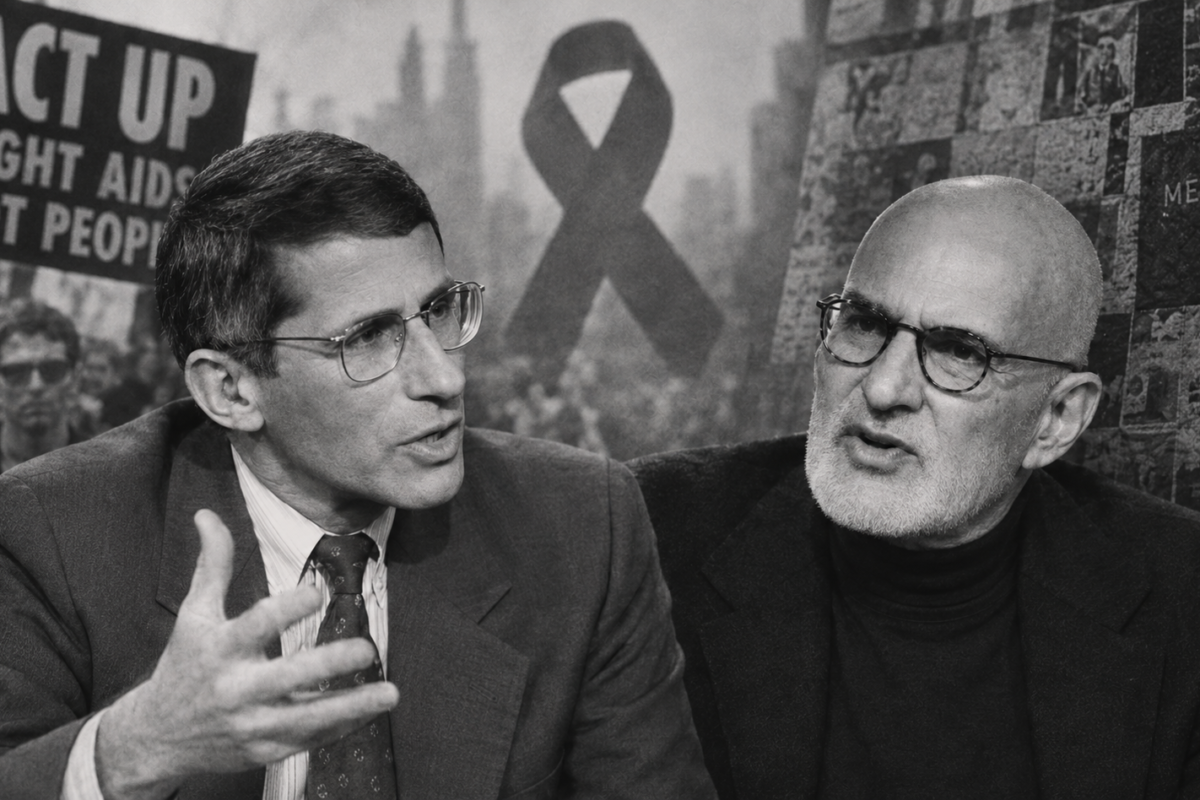
Kramer/Fauci, through October 24th at St. Ann’s Warehouse in New York;
https://stannswarehouse.org/show/kramer-fauci/.

At the height of the HIV/AIDS epidemic, on Nov. 30, 1993, Larry Kramer, the late writer and gay rights activist, sparred with Anthony Fauci, then director of the National Institute of Allergy and Infectious Diseases, on a C-SPAN call-in program over the Clinton administration’s response to the crisis. Journalist Steve Scully moderated the conversation, also taking calls from civilians whose questions and comments revealed varying levels of understanding of the disease and compassion for those living with it and their loved ones.
Daniel Fish’s Kramer/Fauci offers a verbatim staging of this conversation, starring Thomas Jay Ryan as Kramer, Will Brill as Fauci, Greig Sargeant as Scully, and Jennifer Seastone as the various callers. All four listen to the C-SPAN recording through in-ear speakers.
Kramer casts Fauci as the face of an indifferent bureaucracy committing a genocide by inaction. “Tony, if you start that business about, ‘Science isn’t done that way,’” he says, “I’m going to come down there and slap your face.”
“All right, Larry, hang on for a sec,” replies the career public servant. “I love you, Larry.”
They are equal parts allies and antagonists, their genuine affection bubbling through their disagreements and making their complicated relationship [1] especially compelling to watch. What I found less compelling was the machine that releases a tidal wave of bubbles, enveloping Kramer. At one point, Fauci lies near the foam in a Titanic-style “draw me like one of your French girls” pose. If the suds are meant to represent lives lost to AIDS, this image risks reducing an enormous human toll to a theatrical flourish; the absurdism does little to illuminate the government’s inadequate response. Seastone dons roller skates at one point and an inflatable chicken suit at another. Are these props meant to suggest that the titular characters are skating past each other? Playing some game of chicken?
I am still glad I saw the hour-long production. It offers a different experience from watching Fauci sit in a studio or Kramer appear via video screen. The actors roam in the cavernous venue, putting the audience physically inside the conversation. But there is more to theater than the theater itself or theatricality for its own sake—than paltry props and a bevy of bubbles.
Kramer indicates that, despite Fauci’s diplomatic, controlled persona, he is privately frustrated by the political and bureaucratic constraints holding back AIDS research. What if we had seen imaginings of Fauci’s anger behind closed doors? What if we had witnessed how the men’s relationship evolved—how Fauci began working with AIDS Coalition to Unleash Power, co-founded by Kramer, to expand access to life-saving experimental treatments, or how Kramer later shouted at a government hearing, “Tony, I have called you a murderer in the past, but you are now my hero”?
What if the production had used its visual language to illuminate the toll of the epidemic rather than providing sporadic spectacle? Panels from the AIDS Memorial Quilt. Stories of the 700,000 Americans who died. The more than 1 million Americans living with HIV today, with Black and Hispanic/Latino Americans and men who have sex with men among those disproportionately affected.
Otherwise, Fish risks reducing AIDS to a metaphor for COVID-19 and its fallout. Kramer/Fauci should not be relevant only because COVID-19 has reshaped the public’s relationship with science, or because Fauci, three decades later, has once again been called on to defend his work during a plague. It should be relevant because the history it depicts remains unfinished.
C-SPAN recording of the Fauci/Kramer call-in show
Fauci remembers Kramer
[1] Fauci, Anthony. “Anthony Fauci on Larry Kramer and Loving Difficult People.” The New York Times, 4 July 2023, https://www.nytimes.com/2023/07/04/opinion/anthony-fauci-larry-kramer.html.
Web image generated by Medhum.org