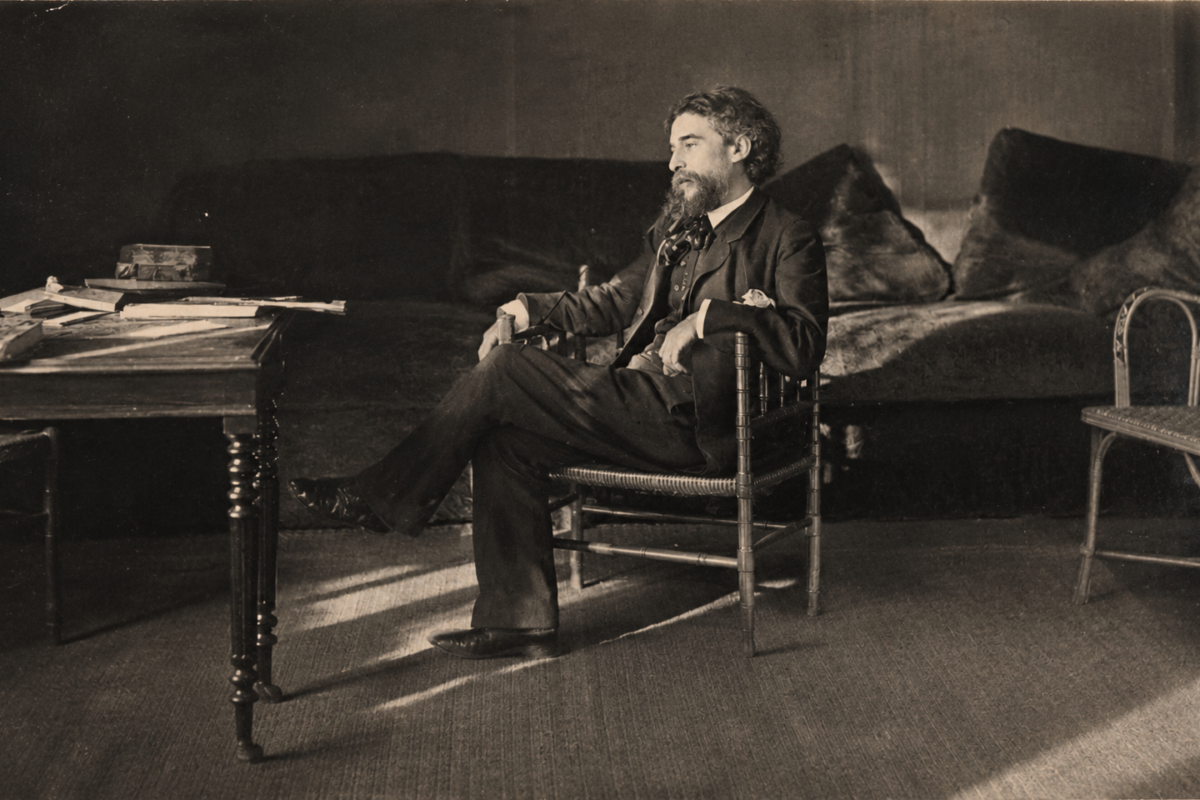
In 1891 the French novelist and playwright Alphonse Daudet wrote, “Doctors are very poor at discerning things. When a patient says to them, ‘I’ve noticed that an egg taken in the morning on an empty stomach brought relief on such-and-such a day,’ they note the observation, but issue the same prescription as for all their patients.” (pp.59-60) Daudet had a lot of experience with doctors. He contracted syphilis as the age of 17, soon after arriving in Paris to start his literary career. More than two decades later, he suffered from tabes dorsalis, a form of tertiary syphilis that progressively destroys the structures of the dorsal column of the spinal cord, leading to lower extremity ataxia, muscle atrophy, and intractable neuropathic pain. From the early 1880s until his death in 1897, Daudet sought help from the leading neurologists of his day, including J. M. Charcot and C. E. Brown-Séquard, but he came to believe that none of these doctors were interested in his experience as a patient. He wrote, for example, that the famous Charcot, who frequently sent patients to the mineral baths at Lamalou, had never personally visited the place to see how his patients were doing.
Daudet tried all sorts of therapy, including mashed bulls’ testicles and elixir of guinea pig. Nothing worked, with the exception of large quantities of morphine and chloral hydrate, which made his life bearable. Daudet also coped with his intractable pain by writing about it. He planned to write a complete memoir of his life with pain, but by the time of his death in 1897, he hadn’t gotten farther than 60-odd pages of notes and reflections. About twenty-five years ago, the English author Julian Barnes translated and collected these fragments into a small jewel of a book called In the Land of Pain.1
The title is illustrative. Those who suffer from chronic pain live in a different country from the healthy, and they gradually find themselves speaking a language that others don’t understand. At first, Daudet introduces details of his discomfort into conversation but soon realizes how repetitive and boring this is to his friends. “Pain is always new to the sufferer,” he writes, “but loses its originality for those around him. Everyone will get used to it, except me.” (p. 19) Daudet finds himself living in a land where suffering is pervasive, “Pain finds its way everywhere, into my vision, my feelings, my sense of judgment; it’s an infiltration.” (p.23) Toward the end he writes, “I’ve passed the stage where illness brings any advantage or helps you understand things; also, the stage where it sours your life, puts a harshness in your voice, makes every cogwheel shriek.” (p. 65)
Although Daudet was not known as a poet, many of these presumably random notes are, in fact, miniature poems. Consider this example: “In the dining room: the man who quite suddenly finds himself unable to read the menu. His wife bursts into tears and leaves the table…” (p. 63) And here is another: “The hotel. The bell-board. The bath times. / Solitude. / Encroaching darkness.” (p. 65)
One of the more depressing aspects of medicine today is the fact that many doctors are still “very poor at discerning things,” at least when it comes to pain. I get a knot in the pit of my stomach whenever I hear a resident discussing whether a patient’s pain is “real” or “imaginary,” or making a cynical comment about drug seeking behavior, especially when the resident herself has prescribed a grossly inadequate course of analgesia. Some of my colleagues believe that a person has to be visibly anguished before they take seriously his reported experience of severe pain. And others get exasperated with patients who describe having more pain than their condition (according to the doctor) warrants, and tell them, “You’re overreacting,” or “It’s all in your head.” When I hear this, I want to shake the physician by their shoulders and yell, “Of course it is! All pain, no matter what causes it, exists in the head. Where else could the experience be generated?”
In the Land of Pain illustrates that chronic pain sufferers can live calm, productive lives despite constant agony. Daudet continued writing, publishing, and socializing until the end of his life, even though he wrote, near the beginning of his journal, “My friends, the ship is sinking, I’m going down, holed below the water line.” (p.7) At the same time, the author’s strength, compassion, and humor illuminate his little book. He emerges as a generous person, who was well loved by his contemporaries. If you were his physician, what would your assessment be?
Would you accuse him of exaggerating his pain because he doesn’t appear desperate?
Daudet refers to his pain as an “unwanted guest,” to whom he intends to give “no special attention.” (p. 79) At another point he reflects on “the ingenious efforts a disease makes in order to survive.” (p. 26) The writer never questions his enemy’s ultimate victory, but neither does he turn in upon himself. He remains a source of joy to others, especially his family, as indicated in this note: “I only know one thing, and that is to shout to my children, ‘Long live life!’ But it’s hard to do so while I am ripped apart by pain.” (p.49)
Chronic pain remains challenging for doctors to treat. One set of barriers are the moral and legal concerns about overuse of opioid analgesics. Questions about the threat of addiction, or the possibility of being manipulated, favor resisting the patient’s suffering, rather than responding with compassion. Many are uncertain about how to proceed because they lack knowledge of treatment protocols that include nonpharmacologic modalities, or referral to pain control clinics for invasive procedures. Alphonse Daudet’s little book invites us to imagine ourselves living, at least for a little while, in the land of pain.
1. Daudet A. In the Land of Pain. Edited and translated by Julian Barnes. New York, Alfred K. Knopf, 2002. (page numbers indicated in the text).
Photo of Alphonse Daudet from Wikicommons.