
Two hidden stories by two famed authors written decades apart in two countries eventually became widely known. One, Anton Chekhov’s, At the Pharmacy, was translated into English in 1998, about one-hundred years after it was published in Russia. The other, Raymond Chandler’s, It’s Alright–He Only Died, was unearthed from its unpublished state by Strand Magazine in 2018, about sixty years after it was written. Though written in different times, and using different scenarios, both stories warn of the barrier money creates to urgent and necessary health care, and of the corrosion in professionalism it causes in providers. They tell of what was to become a defeating feature of Western health care because of financial incentives, social prejudices, and human folly.
Six Kopecks or Your Life

Peter Constantine reached back from the 1990s into the 1880s to assemble a translated anthology of some Chekhov short stories not available to English-speaking audiences. Among the chosen stories in The Undiscovered Chekhov: Thirty-Eight New Stories, is At the Pharmacy.
The story begins when Egor Alexeyitch Svoykin becomes sick. His physician prescribes medicine that a pharmacy would need to prepare. Svoykin felt some relief being in a large Russian city during the late nineteenth century that would have pharmacies he could count on. This feeling of relief dissipated just after entering the pharmacy and coming before the imperious pharmacist there.
The pharmacist eventually raises his head from a newspaper, looks at the prescription, shouts instructions to his assistants, and then returns his gaze to the newspaper while at the same time informing Svoykin the prescription will be ready in an hour. Svoykin is the only person waiting at such a late hour as it was, and he was deteriorating.
His mouth was on fire; there was a drawn-out pain in his arms and legs; foggy images tumbled about like clouds and shrouded human figures in his heavy head. He looked as if through a veil at the pharmacist, the shelves of jars, the gas burners, and the cabinets. The monotonous pounding in the marble mortar, and the slow ticking of the clock seemed to him to be coming not from the outside but from inside his head. (p. 129)
When Svoykin reports to the pharmacist that he is becoming feverish and feeling weaker, “the pharmacist “remained stock-still and, leaning his head farther back, kept on reading his newspaper. He didn’t respond to Svoykin with word or movement—it was if he hadn’t heard him.” (p. 130) When Svoykin subsequently approaches the pharmacist pleading with him to hurry the prescription, the pharmacist again brushes him off saying, “It’ll be ready soon enough…excuse me, but there’s no leaning on the counter.” (p. 131)
The next half hour was “unbearable” before the prescription came and then made more so by the dubious rituals the pharmacist performed in adorning the prescription container. The pharmacist charged one ruble and six kopecks, but Svoykin was short the six kopecks.
Under the circumstances…I would be grateful if you would let me bring you, or maybe send you, the six kopecks tomorrow…
I’m sorry, we don’t accept credit here.
What am I supposed to do?
Go home, get the six kopecks, and then you can have your medicine.
But…I’m having difficulty walking, and I don’t have anyone I can send…
That’s your problem.
pp. 132-133
Svoykin returned home, though with difficulty. The Kopecks were there on the table, but his illness kept him from returning to the pharmacy.
Just Drunk

Strand Magazine is a source for “unpublished works by literary masters.” The October-February (2017-2018) issue includes an unpublished Raymond Chandler short story. Chandler wrote crime fiction for the most part, and the stories usually involved the fictional detective, Phillip Marlowe. This story, however, written between 1956 and 1958, is about a person brought to a hospital emergency room and denied service for financial and social reasons.
As the story opens, a man who has been hit by a truck is brought into the emergency department at General Hospital. He arrives just before shift change and so the admitting clerk is already annoyed about having to assess him. The clerk checks the patient’s pockets for the required $50 deposit and finds nothing, so she could now send the patient to the county hospital, and that would be that. But, before she initiates the transfer, she asks a passing private attending physician to look at the patient. He sees that the patient is dirty, smells of alcohol, and would cost a lot to work up. Mindful of an admonition from a major donor that the “hospital is not run for charity,” the physician surmises the patient is “just drunk,” and agrees the patient should be moved to the county hospital. Off the patient goes.
The next day, the same admitting clerk at General Hospital gets a call from the county hospital. She’s informed that the patient they transferred had a head injury requiring surgery, and that the patient had $4,000 in a money belt inside his undershirt. The patient couldn’t be saved, however, because of the delay involved in the transfer to the county hospital. “It’s all right—he only died.”
Fast Forward
If they could have foreseen the current time when they wrote these stories, 140 years ago for Chekhov and 70 years ago for Chandler, they would have realized that the scenarios they created became commonplace and institutionalized in many ways.
Pharmacists may not go unseen behind a newspaper as Chekhov’s pharmacist did, but they may be buried under insurance company paperwork or piles of prescriptions needing to be filled. And certainly in a few situations, perhaps only independents, do pharmacists have ways to cover costs when patients are short on cash, credit, or insurance coverage. They are very likely to send patients away to get money even when they are very sick.
Hospital personnel do not now actually reach into the pockets of unconscious patients to see if there’s enough cash for admission as Chandler conjures in his story, but he would see them still check for money in the form of insurance cards or proof of sufficient financial means. He would also see that the scenario he described in which patients without money get transferred to county hospitals had progressed to a degree that people are moved around among different health care providers based on health care insurance plan coverage or lack thereof. But the poor treatment of patients in need of emergency care can even occur in the “right” hospitals when they are held for hours to days in hallways or holding wards for beds to become available.

Scenarios such as these can and have been addressed to varying degrees through government welfare programs, regulatory requirements, technology advances, and professional practice standards among other responses. The two stories, though, also expose human folly not so amenable to these actions. What can be done about the pharmacist who won’t put the newspaper down to address the needs of a person seeking help for an acute illness? What can be done about the physician who after a cursory evaluation brushes off an unconscious patient as “just drunk?”
Chandler makes an attempt at addressing the human folly he and Chekhov reveal by describing how it fails humanity on both professional and personal levels, and in shaming the character, who is ostensibly standing in for those behaving as this doctor in the story did.
All he had done was disgrace himself as a person, as a healer, as a saviour of life, as a man required by his profession never to turn aside from anyone his long–acquired skill might help or save…Why should a doctor in such circumstances be better than other men? The answer is simply, that if he isn’t, he is not a doctor. The $4,000 would have made quite a difference in this case, wouldn’t it? Should it?
Chekhov and Chandler are perhaps hoping that those in the care of others will exhibit more humane and professional behaviors when they ask themselves many decades later: “Am I a doctor?”“Am I a pharmacist?” “Am I a human being?” Would it make a difference? Should it?
Notes
Title image:
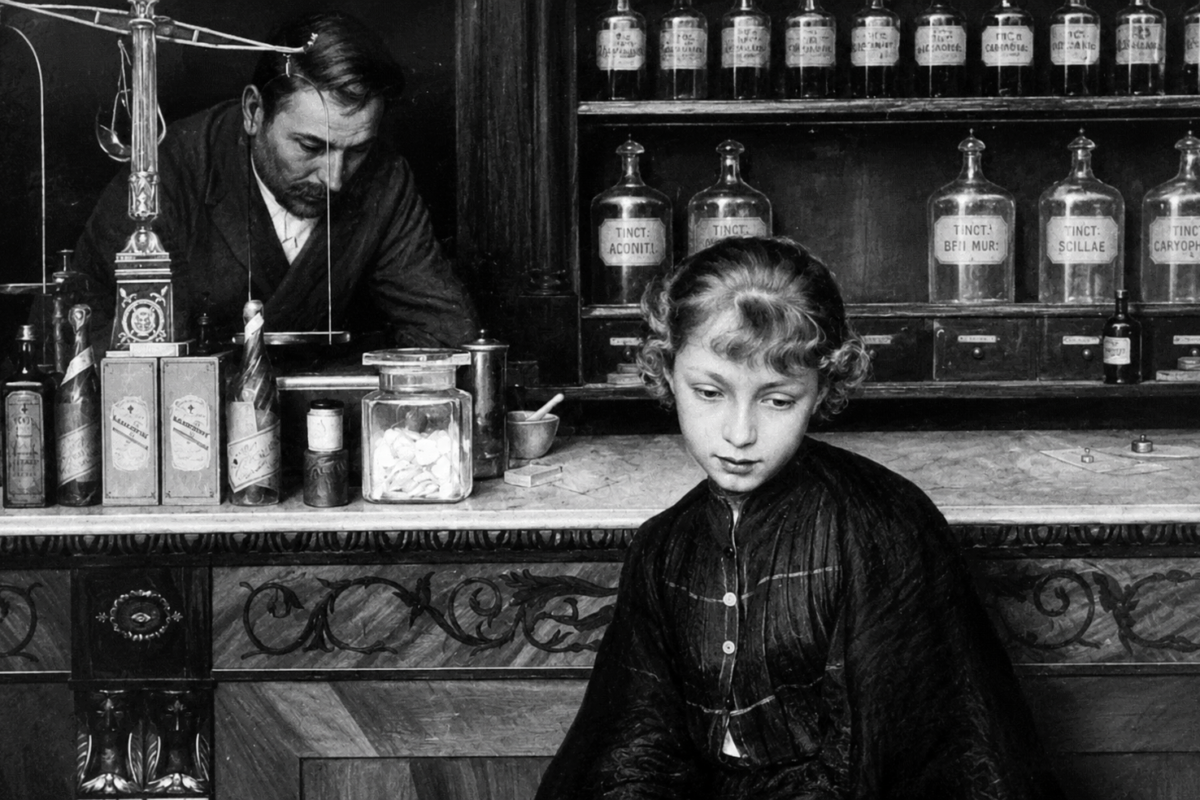
A young girl waiting for a pharmacist to make up a prescription.
Photogravure, 1912, after J. Jendrassik, 1896
Licensed under the Creative Commons Attribution 4.0 International
End image:
Nurse Aide Rocky FordHospital CO
Mennonite Church USA Archives, No restrictions, via Wikimedia Commons