As the world began lifting COVID-19 safety precautions, many disabled and immunocompromised people felt left behind. Bec Miriam, who is chronically ill and neurodivergent, was unable to attend film festivals showcasing their work—some of it award-winning.
“That was a barrier I wanted to address because I know I’m not alone in that experience,” says Miriam, who lives in California.
And so, in the spring of 2023, they founded RestFest, described on its website as an online “gathering space and virtual film & video art festival created by/for the Disabled, Deaf, Chronically ill, Neurodivergent, and/or Mad arts community worldwide.”
This year’s festival is available to stream anytime in February—and viewers are invited to watch from bed. RestFest operates on “crip time,” recognizing the different pace at which disabled people may go through life due to their sensory, physical, or cognitive needs. Crip time rejects ableist productivity norms and offers inclusivity and comfort instead.
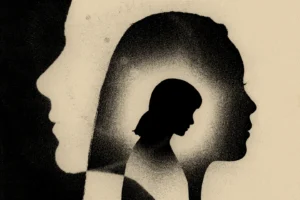
“This Werewolf Complex,” one of the 27 short films and video artworks, adroitly dramatizes an epileptic aura through hallucinations of SpongeBob SquarePants and Rorschachian patterns that morph into human silhouettes. Another work—shifting the meaning of aura from a focal seizure’s onset to aural gestalts—deftly considers how Deaf people access sound in their minds through sight, touch, and imagination.
While all of the works screened are made by disabled or chronically ill artists, not all of them are about disability or illness. Nor are they intended to educate non-disabled viewers (though RestFest is open to everyone).
Rather, RestFest taps into an “inherent mutual understanding between community members,” Miriam says. “I’ve had filmmakers who showed films reach out to me and say that they could tell the audience understood their work in a way they hadn’t seen before, which is really special.”
Similarly, Sammy Holden says that if they were to submit their work “Night Holding Still”—which dreams a path through the shame of their chronic illness—to an experimental film festival, “it might be fine.”
“But reaching audiences who will potentially understand it more directly is just something that I think can only happen at a festival like RestFest.”
Beyond Words
The realities of disability are often ineffable. Reflecting this, many of the festival’s works are experimental, which “leaves space,” Miriam says, “for sitting in the uncertain and the unknowable.”
“Verbal language isn’t accessible for everyone,” adds Georgia Kumari Bradburn, a British filmmaker whose “A Brief History of Circles” uses sounds and objects to capture how she processes sensory information as an autistic person. A voiceover narrates the history of circles as flowers, logos, and other structures in that shape appear onscreen.
Eventually, hyperfixation escalates into meltdown. Objects blur and merge as the voiceover reverberates and multiplies, mirroring how euphoria can turn into overload for Bradburn.
And then a new, calmer obsession takes hold. It is a mathematical law that two perpendicular sine waves, moving in step, form a circle; the voiceover repeats the word “sine,” followed by shots of a shoreline. Bradburn’s fingers trace the water’s surface—a subtle yet powerful act of self-stimulatory behavior, or stimming. “That’s me transferring my sensory experience to the audience through something as intimate and simple as touch,” she says.
As part of the festival, Bradburn will lead a workshop on the “autistic camera,” which proposes the camera as a tool for autistic expression. A camera might stim, for instance, by circling a scene.
Not Explaining—Exploring
Troels Steenholdt Heiredal, an architect and artist, didn’t discover he was autistic until his 30s. “It was the best thing that had ever happened to me,” he says, “because it gave me a language with which to write myself back into my own life.”
His relief exemplifies the phenomenon of metagnosis, whereby “one becomes newly aware, in adulthood, of a lifelong ‘condition,’” writes narrative medicine scholar Danielle Spencer [1]. This recognition catalyzed a profound exploration of urban space, perception, and accessibility—an inquiry rooted in his lived experience and often overlooked in conventional architectural discourse.
Heiredal’s documentary short “Not Included—Embedded” explores his “Autistic architectural approach,” a framework that posits disability as a generative force rather than a limitation.
Raised in a small town in Denmark, Heiredal currently lives in Taipei. “The way that public space is being used is beautiful,” he says. Through mimetically arranged clips, some of shopfronts doubling as dance studios, his film presents a disabled reading of the Taiwanese capital’s traditional informal architecture—buildings and structures designed by residents, not as high-profile projects, but emerging organically. Heiredal depicts the metropolis as a symphony of its residents’ spatial voices.
Drawing on theorists like Erin Manning, who frames neurotypicality as a system that decides whose lives matter and whose do not [2], Heiredal challenges inclusion that ends with ADA-compliant ramps, arguing that disabled knowledge should more broadly shape how we build the world. For example, he suggests in a recent essay [3] that hosts create spaces where guests can retreat from overstimulation and craft environments that foster shared-interest interactions. To those ends, a host might furnish a quiet corner with cozy chairs, or intentionally spark a conversation between two guests who don’t know each other but both love, say, experimental films.
“I’m not interested in dictating what an Autistic architectural approach is… it must be co-created,” continues Heiredal, who will expand on these ideas in a talk at the festival.
Even before he developed this concept, he had been guided by intuition in his work. “The teachers around me encouraged me to just explore what is there without always needing to explain it, and I feel very lucky in that,” he says. “It’s allowed me to do a lot of things that I didn’t necessarily know how to explain.”
RestFest embodies this sentiment. And, in that spirit, when he found his grandfather’s old 35mm film camera, he started photographing Taipei. “It felt right to do it this way.”
Access and Care
The films and video artworks are grouped into categories defined by the sensations they may evoke: “rumbling,” “inside/outside,” “spaces/routes,” “reverberation/held,” and “mid-air/suspended.” All provide closed captioning and audio description, written or recorded, in many cases, by the artists themselves. One vivid example: In her short film “Song Without Words,” deaf visual artist Olivia Ting plays with typeface and lettering to echo the partial inaccessibility of hearing devices and sign language, and to portray listening as a bodily, interpretive act.
The festival also features 17 virtual events—among them Bradburn’s and Heiredal’s aforementioned programming, as well as a discussion with Holden and another U.K.-based artist on transgressing genre and gender in film. These events incorporate captioning, transcription, and audio description, along with low-sensory breakout rooms, live access support, and permission to stay comfortable—whether that means lying down, staying off-camera, communicating via chat only, leaving early, or something else. RestFest’s film and readings clubs and arts gatherings, held year round, also offer these accommodations. As disability scholar May Chazan writes, “In our care-filled, artful practices, we slowly make our next world.” [4]
The first event is a workshop on processing pandemic grief, and the final event will be a screening of a collective film created during the workshop. Facilitator Kit Blamire, a self-identified “anarcho-sicko” artist living in Berlin, organized the same event last year. Participants made one-minute films, which were later assembled together.
“Folks were talking about how, since they became very ill, they hadn’t been able to make films anymore—and then, coming into this space, they were inspired to make films again,” recalls Miriam, the RestFest founder.
“I’m disabled,” these attendees said, “but all these other disabled people are making films in these creative ways that are comfortable for their minds and bodies.”
RestFest Film Festival, through Feb. 28; restfestfilmfestival.org. “No need to get out of bed or off the couch. No worries if you’re half-asleep. You are always welcome here.”
[1] Spencer, Danielle. Metagnosis: Revelatory Narratives of Health and Identity. Oxford University Press, 2020.
[2] Manning, Erin. The Minor Gesture. Duke University Press, 2016.
[3] Heiredal, Troels Steenholdt. “Autistic Architectural Approach.” PLAT, vol. 13, “Alchemy,” 2025. static1.squarespace.com/static/611838bd3f0e670d00f832f5/t/6796f49bc98eac6ba1880af5/1737946272880/Heiredal-Troels+Autistic+Architectural+Approach.pdf.
[4] Chazan, May. “Crip Time and Radical Care in/as Artful Politics.” Social Sciences, vol. 12, no. 2, 2023, pp. 59-75. MPDI, doi.org/10.3390/socsci12020099.
Web image from RestFest Trailer.