


When asked why she wrote “The Yellow Wallpaper,” Charlotte Perkins Gilman, also known by the surname Stetson, asserted that the short story “was not intended to drive people crazy, but to save people from being driven crazy, and it worked” (p.804).
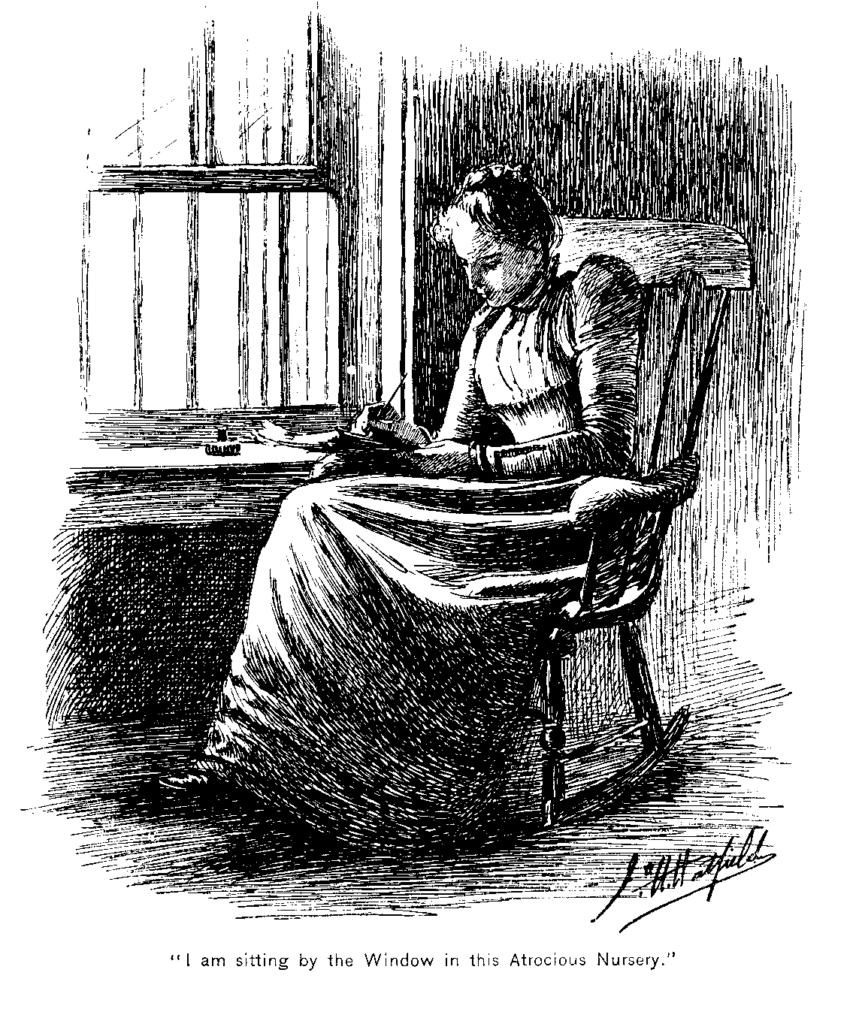
The short story follows a woman who has been sent by her physician to a colonial mansion in the country as treatment for postpartum depression. The woman, who remains nameless, is constantly dismissed and belittled by her husband, who is also a physician. He speaks to her patronizingly and ignores her protestations that the “treatment” she is being given is making her worse instead of better. She is told not to think, and not to write, and her husband believes that since he sees no reason for her suffering, it does not exist. She is kept upstairs in the mansion’s nursery, isolated behind bars and gates that she believes to be there for children’s safety, when in actuality they function to keep her imprisoned. As time passes, the woman believes that she perceives something in the wallpaper and becomes convinced that it is a trapped woman. She believes the woman is confined behind bars within the wallpaper, which mirrors the trapped feelings that she herself is experiencing living day in and day out inside the confines of the nursery. Her desire to help the woman escape, which mounts to a frenzy, is reflective of her own desire to be free from the nursery and the rest cure.
Throughout the story, the titular wallpaper functions almost as another character as it’s brought to life in the narrator’s mind. She contrasts the vitality of the wallpaper with the “dead paper” upon which she is writing the journal entries that make up the narrative. Her fascination, and disgust, with the wallpaper drive the story as she investigates its pattern and condition, and then ultimately determines that there is someone living within it. The narrator’s disdain for the paper is obvious in her descriptions; for instance, in her first mention of the wallpaper, she writes “I never saw a worse paper in my life” (p. 793). She later writes that the print was “One of those sprawling flamboyant patterns committing every artistic sin” (p. 793). On the topic of its hue, she writes that “The color is repellent, almost revolting; a smouldering unclean yellow…a dull yet lurid orange in some places, a sickly sulphur tint in others” (p. 793). For all of her disgust with the wallpaper, and its damaged and torn condition, she still finds herself fascinated by it, and this fascination turns into obsession, which later turns into madness.

“The Yellow Wallpaper” works so effectively because it allows the reader to step into the mind of a woman as she is driven to madness. The structure of the story, which is told in an epistolary format, adds to the reader’s affiliation with the narrator as there is an intimacy in reading her journal entries and being in on the secret that she is writing against her husband’s orders. This affiliation helps to build empathy between the reader and the narrator, which contributed to the concern that I felt for the woman when she slowly lost her mind. If the story helped to save people, as Gilman hoped, it did so because it made them see the human being at the center of the “illness” and “treatment,” forcing them to understand what truly happens when you isolate someone and take away their ability to do what brings them joy. We bear witness as the woman loses her mind, leaving us with an intimate picture of what the rest “cure” could truly do to someone’s psyche. Instead of viewing postpartum depression solely as a condition to be treated, “The Yellow Wallpaper” makes readers realize that there is a person at the center whose needs and voice deserve attention.
In a patriarchal era in which women’s voices and lived experiences were ignored in favor of what the men around them deemed to be “best,” “The Yellow Wallpaper” offers an important and valuable perspective – that of the woman herself. By placing the female patient’s voice at the forefront of her story, Gilman gives her narrator the agency that had previously been stripped from her, to tell the story of her postpartum depression and how the prescribed treatment drove her to madness instead of restoring her health. It is a reminder to each of us that the voice of the patient is of paramount importance in any instance in which an embodied condition is being treated. When we ignore the patient, and what they need, they are lost, pushed to the background, and left to disappear into their own metaphorical wallpapers.
Works Cited
Gilman, Charlotte Perkins. “The Yellow Wallpaper.” The Norton Anthology of American Literature, edited by Nina Baym and Robert S. Levine, W.W. Norton & Company, 2012, pp. 804.
Originally published by The New England Magazine, Boston, 1892
Image Credits
Illustration for ”The Yellow Wall-paper” by Joseph Henry Hatfield, 1892 from Wiki Commons
Book cover by Small, Maynard & Company, 1901 from Wiki Commons
Web image from Medhum






One of my favorite short stories; great description of a descent into insanity…