
Sinclair Lewis’s Arrowsmith (1925) is something of a miracle. It marks a dramatic shift in the American imagination from viewing scientific doctors as monsters to viewing them as heroes, even Great People.
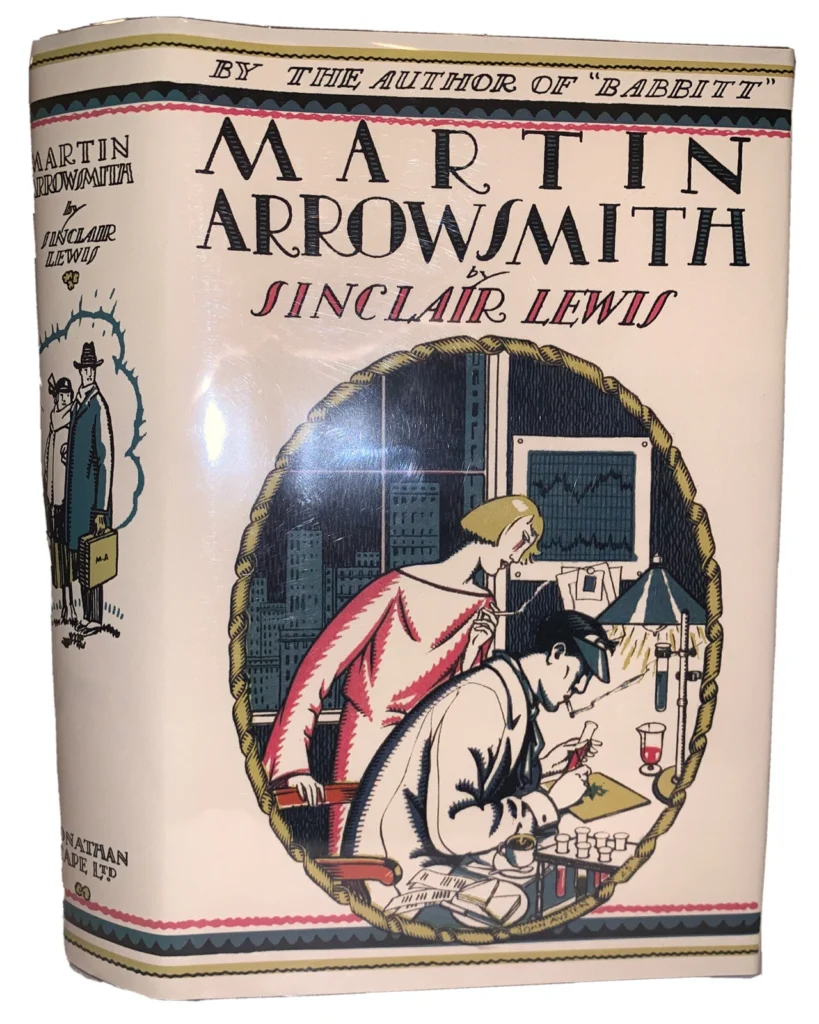
The novel follows Martin Arrowsmith from a small Midwestern town to the upper reaches of American research science. As a boy in Elk Mills he reads anatomy in the town doctor’s office, and at the University of Winnemac he falls under the spell of Max Gottlieb, a German bacteriologist who teaches him to distrust easy answers and love the laboratory above the clinic. Martin’s career moves quickly from medical practice into research as a vaccine discovery vaults him from a small-town practice into a prestigious New York institute, and finally to a Caribbean island where bubonic plague is raging. There he faces an ethical conundrum: whether to withhold his unproven cure from half the population to prove it works, or whether to save as many as he can without conclusive evidence. When his wife Leora dies in the experiment, Arrowsmith throws caution to the wind and immunizes everyone, sacrificing his chance at greatness. In the aftermath, he walks away from money, marriage, and fame to chase pure science in a rural cabin, leaving the reader to decide whether he’s really a hero or just a reclusive crank.
Lewis wasn’t the first American writer to champion medical science. Willa Cather and Oliver Wendell Holmes laid some of this ground first. But biographer Mark Schorer isn’t wrong in saying that “Martin Arrowsmith was a new hero, scientific idealism a new subject, and scientific individualism a new (and rather unscientific) perspective.” And Lewis was probably the first American writer to coauthor a major novel with a scientist, the bacteriologist Paul de Kruif.
Arrowsmith won the Pulitzer in 1926 (though Lewis refused to accept the award), and the novel was a major factor in the Swedish Academy’s decision to award Lewis the Nobel Prize in 1930. It represents a hard-fought accord between science and art that has vanished from the literary scene today. But it’s hardly a one-note celebration of science. Lewis suggests that once scientific medicine withdraws from public view, the ominous tropes of the nineteenth century may creep back in.
Like most of Lewis’s novels, Arrowsmith is filled with overwritten scenes and dialogue riddled with slang. But I’d be curious, if I could teach it to medical students today, how much of themselves they might see in the character of Martin Arrowsmith, a boy from flyover country who nearly rose to medical immortality but crashed, Icarus-like, on his own hubris.

A Novelist and a Whistle-Blower
Lewis was immersed in medical culture throughout his young life as the son of a rural physician, but he was not a scientist himself, and never aspired to a career in medicine. His father, Edwin J. Lewis, began his medical training at Rush Medical College in 1875, graduating two years later as an M.D. and eventually opening a small practice in Sauk Centre, Minnesota, where he advertised himself as a physician and surgeon. Memories of his father provided a general basis for the opening scenes of Arrowsmith, set in rural Winnemac (or Minnesota), but Lewis needed to grasp both the passion and methodology of real scientists to create his medical hero.
Lewis met his coauthor, Paul de Kruif, at a meeting arranged by his publishers. De Kruif held a Ph.D. in bacteriology from the University of Michigan. He had also worked as a researcher at the Rockefeller Institute in New York, but had been fired after the director discovered that de Kruif had published an anonymous exposé of the Institute’s financial corruption and premature publication of scientific results. He was an ideal partner for Lewis, whose satires of the American Midwest elevated skepticism to an ethical ideal. As E. L. Doctorow observes, “Expecting his countrymen to be more than they were, looking for a resonant truth and righteousness, Lewis had found an American spiritual life that could elicit from him nothing more than bitter derision.” Lewis and De Kruif counterbalanced one another professionally, one steeped in medical science, the other in literary art, but they were both truth-seekers, through and through.
De Kruif was professionally destitute when he met Lewis, having recently lost his position at the Rockefeller Institute. He had seriously jeopardized his chances of finding work in his field, as university bacteriology departments and pharmaceutical companies balked at hiring known whistle-blowers. He needed Lewis and the stimulus of a major literary project as much as the author needed his expertise.
Lewis gave De Kruif “assignments” during their travels, such as writing a fictional biography of Gottlieb, Arrowsmith’s mentor. The apprenticeship would later pay off for De Kruif, who became a bestselling author of scientific history just one year after the publication of Arrowsmith. His book The Microbe Hunters, which sold over one hundred thousand copies in 1926, alone, was one of the major nonfiction books of the decade.
Indeed, De Kruif learned literary craft so well that it’s impossible to know who wrote certain passages in Arrowsmith. Take, for instance, the scene where Martin realizes that he is about to make a potentially groundbreaking scientific discovery about the behavior of bubonic plague. Late at night, alone at the McGurk Institute (the fictionalized Rockefeller Institute), Arrowsmith simply can’t wait to process his lab results:
At a hectic run, not stopping for lights, bumping corners and sliding on the too perfect tile floor, he skidded down the stairs and galloped through the corridors to his room. […]
Then he forgot…war, night, weariness, success, everything, as he charged into preparations for an experiment, his first great experiment. He paced furiously, rather dizzy. He shook himself into calmness and settled down at a table, among rings and spirals of cigarette smoke, to list on small sheets of paper all the possible causes of suicide in the bacteria.
Lewis and De Kruif collaborated so intimately that the scientist began to write like the novelist and the novelist began to think like the scientist. They should have shared the honors that followed, but Lewis insisted on crediting De Kruif more as a fact checker than as his equal.
Cruelty or Cure?
It’s hard to imagine language like this from a doctor now, but Martin Arrowsmith dedicates himself to the search for “the Why that made everything so.” Impatient with memorizing facts, he “wanted to look behind details and impressive-sounding lists of technical terms for the causes of things, for general rules which might reduce the chaos of dissimilar and contradictory symptoms to the orderliness of chemistry.” Arrowsmith believes in precise technique, but he’s also emotionally invested in the work, demonstrating an almost fanatical belief in the scientific method.
His defining characteristic is his curiosity, which helps him crack riddles others see as mere aberrations. Lewis writes, to this effect:
Now in Martin Arrowsmith there were no decorative heroisms, no genius for amours, no exotic wit, no edifyingly borne misfortunes. He presented neither picturesque elegance nor a moral message. He was full of hasty faults and of perverse honesty; a young man often unkindly, often impolite. But he had one gift: curiosity whereby he saw nothing as ordinary.
When he sees something weird in his test tubes, he says, “Now there was some cause for that, and I’m going to find out what it was.” This is how Arrowsmith discovers the X Principle. He tells his wife Leora that it could lead to the cure of every germ disease, which overstates the case, but it is a major scientific breakthrough—not only for Martin, but potentially for humankind.
Arrowsmith’s X Principle is a remarkable development in the novel. Perhaps for the first time ever in American fiction, Lewis invites a reader to participate in the euphoria of scientific discovery, rooting for the medical scientist as he plugs away in the laboratory. Later he causes a stir among the farmers in Wheatsylvania, the little town where he briefly sets up a private practice, by curing a seemingly unstoppable blackleg epidemic with an original vaccine prepared in the makeshift laboratory at the back of his doctor’s office. The vaccine requires several experimental dry-runs, but Martin works on the project after hours, glad to be searching for the root cause—the Why—of the disease.
Later, Arrowsmith travels to St. Hubert, a fictional Caribbean island, to test the X Principle on a population besieged by bubonic plague. Verifying the efficacy of his bacteriophage would require a control group, which would mean denying the remedy to a portion of the populace. Is it more compassionate to inoculate everyone with an unproven (but promising) remedy or to withhold treatment for conclusive proof, thereby guaranteeing the health of future generations? It’s an important ethical question, but one that politics ignores. It’s hard to name a doctor today who is both publicly promoting scientific knowledge and defending human rights in quite this way.
Arrowsmith develops a high-stakes debate over humanitarianism. One doctor argues that temporary cruelty does not justify eventual compassion; accordingly, he refuses to receive the preventive bacteriophage inoculation until the entire population of St. Hubert has been immunized. Arrowsmith’s mentor, Gottlieb, insists that true humanitarianism requires establishing irrefutable scientific facts. Gottlieb corners Arrowsmith before he leaves for St. Hubert and delivers one of his longest speeches of the novel. The St. Hubert experiment is Martin’s chance to become a “Great Man,” and Gottlieb intensifies the pressure:
Be sure you do not let anything, not even your own good kind heart, spoil your experiment at St. Hubert. I do not make funniness about humanitarianism as I used to […]. So many men, Martin, are kind and neighborly; so few have added to knowledge. You have the chance! You may be the man who ends all plague […].
You must not be just a good doctor at St. Hubert. You must pity, oh, so much the generation after generation yet to come that you can refuse to let yourself indulge in pity for the men you will see dying.
As I write this, doctors are taking to Instagram to protest insurance companies who deny patients coverage for life-saving procedures. We’re having a hard enough time helping people now; no one is talking about the generation after the generation yet to come. But this is what Lewis imagines in Arrowsmith’s unorthodox heroism: by withdrawing from society into the laboratory, as he does to prepare his blackleg serum or to discover the X Principle, Arrowsmith has a chance to become a legendary benefactor of public health. But is the greatest degree of human compassion possible only through momentary cruelty?
Arrowsmith’s heroism might have been lost on the popular audience had Lewis seen the St. Hubert experiment through to the end. Instead, Lewis creates a strategic compromise. First, he sets up the conditions of the experiment, outlining arguments for and against denying the vaccine to portions of the St. Hubert population; this lends credibility to Martin Arrowsmith as a scientific physician by highlighting the complexity of his choice. Then Lewis derails the experiment with the accidental death of Arrowsmith’s wife Leora, who dies suddenly of plague. Stricken with grief and guilt (because he had been entertaining adulterous thoughts at the time of her death), Martin begins administering his serum indiscriminately to the people of the island, compromising the scientific integrity of his results, but demonstrating his capacity for emotion.
After Leora’s death, he returns to the self-destructive behavior of his vagrancy during medical school, drinking heavily and acting as if he no longer cares about knowledge or the accompanying reward of fame. Lewis writes: “[…] all day, Martin injected a line of frightened citizens, in the Surgeon General’s office,” during which time he “had a bitter satisfaction in throwing away all his significance, in helping to wreck his own purposes.” In the end, no one knows whether the plague disappears from St. Hubert as a result of “phage or rat-killing or Providence.” The result is tragic by Gottlieb’s standards, but it further endears Arrowsmith to readers, whom Lewis manages to educate about the ethical quandaries of research science while introducing the research scientist, himself, as a man of passion and human weakness.
Arrowsmith loses his chance to enter the historical record alongside scientific greats such as Pasteur, but Lewis reinforces his heroic stature on the human level. Alongside characters like Hawthorne’s Rappaccini who becomes so obsessed with science that he forgets humanity, Arrowsmith’s capacity for emotion in the heat of his greatest experiment is extraordinary. In fact, I’d like a little more evidence that grief, for today’s doctors, is as powerful as scientific curiosity, profit, or personal branding. We could use more reminders that science happens in social contexts and that it is vulnerable to the weaknesses and biases of those who do it and the systems that support it.
A Flawed Hero

Arrowsmith is a bildungsroman—the first to show how an ordinary person becomes a scientific hero—but it borrows from other literary forms, such as the epic and the portrait of the artist.
Martin is raised in a small town called Elk Mills, where he is the “unofficial” assistant to Doc Vickerson, the self-styled “plug doc” and alcoholic who has managed to compile the first museum of natural history in the county. In a drunken speech, Vickerson tells the young Arrowsmith to get all the training he can in the sciences in order to realize his full potential as a physician. “Set a high goal,” he admonishes Martin. “Don’t let things slide. Get training. Go college before go medical school. Study. Chemistry. Latin. Knowledge!” A nice little pitch for the liberal arts, even if it sounds quaint to us now.
The University of Winnemac is Arrowsmith’s portal to opportunity, where preparation for medical school consumes his life. His entire identity revolves around his education, where “the purpose of life was chemistry and physics and the prospect of biology next year.” Arrowsmith’s junior year of college is set in 1904, and the descriptions he hears of Gottlieb, his professor of bacteriology, reflect lingering stereotypes of the medical scientist as a rogue. Rumors about Gottlieb suggest that “he was doing terrifying and costly experiments which probably had something to do with human sacrifice. It was said that he could create life in the laboratory, that he could talk to the monkeys which he inoculated, that he had been driven out of Germany as a devil-worshiper or an anarchist.”
Gottlieb, whose name translates literally from German as “Godlove” and more accurately as “Beloved God,” recalls the master-apprentice relationship typical of the bildungsroman through his mentorship. From his introduction in the Winnemac scenes, Gottlieb remains the dominant influence on his young protégé throughout the remainder of the novel. When Arrowsmith asks to be admitted into his course before having taken all of the prerequisites, Gottlieb says:
There are two kinds of students the gods give me. One kind they dump on me like a bushel of potatoes. […] The other kind—they are very few!—wish a liddle [sic] bit to become scientists, to work with bugs and make mistakes. Those, ah, those, I seize them. I denounce them. I teach them right away the ultimate lesson of science, which is to wait and doubt. Of the potatoes, I demand nothing; of the foolish ones like you, who think I could teach them something, I demand everything. (11)
He goes on to tell Arrowsmith that he must take physical chemistry before he will be ready for bacteriology; this is the difference between true scientists and imitators. Gottlieb’s first public experiment, an inoculation of guinea pigs with anthrax repulses many of Arrowsmith’s classmates, but the young Martin later imagines himself repeating experiment: “as he remembered Gottlieb’s unerring fingers, his hands curved in imitation.”
But Arrowsmith needs flaws if he is to be taken seriously as a character, and he nearly destroys himself at several crucial moments in the narrative. The same restlessness that fires his curiosity is also his potential undoing—binge drinking makes him careless in the laboratory and lack of sleep makes him belligerent. When Gottlieb reprimands him for a series of avoidable errors, Arrowsmith’s defiant response nearly ends his medical career. The medical dean decides to suspend rather than expel him, and Martin is temporarily exiled from the University that has been the primary touchstone for his identity as a young adult.
But Arrowsmith’s flaws show that the most promising benefactors of public health sometimes seem the most misanthropic by nature. For Lewis and De Kruif, two idealists who effectively replace religion with science, pure science requires complete devotion. This is a high standard that none of Lewis’s characters fully attains; it’s in their failings that he endears them to readers, unveiling the joys and heartaches of a scientist, making the doctor’s emotional life known.
Back to the Lab, Out of the World
If the novel were to end in St. Hubert with Martin Arrowsmith doling out medicine to everyone in sight, it might be a story about compassion defeating cold-hearted science. Leora would be a martyr and Martin would be a widower, unselfishly serving humanity. But the story doesn’t end there: Martin marries Joyce Lanyon, a wealthy woman from New York, and briefly celebrates the birth of a son before divorcing Joyce, abandoning his son, and withdrawing to a remote cabin to dedicate his life to research. Arrowsmith is hard to like as a deadbeat father and cultural isolationist. Why, after taking such pains to help us understand the beauty and importance of science through Arrowsmith’s life, would Lewis turn his hero into such a miserable person? Is that really what science does to the heart?
Lewis leaves us with a paradox. Nearly all of Arrowsmith’s flaws are scientific virtues: his brutal honesty, his distaste for wealth, his comfort with solitude. But Arrowsmith’s most troubling implication is that the medical scientist might give up trying to communicate with the public at all, choosing, instead, the uninterrupted calm of the laboratory, where discoveries happen unseen. When that happens, we’re thrown back to the distrust of the nineteenth century. Are the researchers devoted to unlocking the great Why beneath physical things today doing it for themselves or for humanity? Are they Arrowsmiths or Rappaccinis?
The public story of medicine is a balancing act. It requires careful translation of facts into culture. It’s hard work, and it never ends. It’s much easier for suspicion to prevail.
That’s why I see Arrowsmith as a miracle. Think about what it took for that book to exist. It took a Paul de Kruif: a researcher with enough integrity to sacrifice financial gain for truth-telling. And it took a Sinclair Lewis: a kindred spirit who was willing to make an artist of a lab scientist.
In Martin Arrowsmith, the scientific physician comes of age as a character, no longer a shadowy villain, but an artist in his own right: a figure whose potential for greatness or failure extends the medical narrative to the full scope of human experience.
Web photo: Wiki Commons