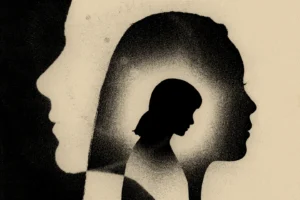
In his early poems Chicano poet Gary Soto wrote frequently about being between cultures (Mexican and American), and of the anxiety as well as humor in the situation. In “Mexicans Begin Jogging” Soto addresses the dilemma of traveling the path between two cultures. Because he is brown skinned and lived in a border culture, it was often assumed that he could not be a “real” American. Here he describes an incident that occurred when he was a factory worker in a plant that employed Mexican illegals. When the border patrol raided the plant, the boss assumed that Soto was also illegal. Soto “shouted that I was American” but the boss didn’t believe him, and Soto was forced to run away along with the others.

Soto explores his uncertain status in relation to his family, and to the larger society in “You’ve Gone Too Far.” Detailing the “evolution” of his siblings and cousins, who “were no longer Mexican rednecks,” but “held down jobs” and “stopped jamming parking meters for free time,” Soto describes how his family nevertheless feels uncomfortable about him. “My family feared that I had evolved too far.” Drunken Christmas horseplay with his brothers reveals their distaste and distrust of his intellectualism and sophisticated clothes. “They tore my book in half, / and stripped me of my Italian belt.” Only when they have succeeded in making him sick/drunk do they accept him (at least temporarily) back into the family fold. The poem illustrates well the difficulties that can arise when one member of a family elects to live life differently from the rest yet wants to maintain a relationship with its members. The situation has resonance for the children of immigrants, for children who are more educated than their parents, or for anyone who has chosen a life unfamiliar to family or friends.
“TV in Black and White” focuses on the role of television (in the 1950s/1960s) in shaping, reflecting, and failing to reflect American society. Soto remembers his childhood in which “[we] were sentenced to watch / the rich on TV …”. Sitcom characters played golf, ate steak, and dressed fashionably (the Donna Reed Show, Ozzie and Harriet). “While he swung / we hoed / Fields flagged with cotton . . .”
Now life is for many relatively luxurious, “Piano lessons for this child, / Braces for that one — “ “But if the electricity / fails in this town, / a storefront might / be smashed /” “and if someone steps out / with a black-and-white TV, / it’s because we love you Donna, / we miss you Ozzie.”
Soto’s critique is still relevant today. The ubiquity of television and streaming, even in low-income households, confers enormous power on the images and narratives presented. Now there are many more options for viewers of different cultural and economic backgrounds. Yet the dominant culture still exerts a major influence. The gap between representation and reality continues to be an important source of social dissatisfaction and unrest.
Gary Soto
https://garysoto.com/
https://www.poetryfoundation.org/poets/gary-soto#tab-poems
Mexicans Begin Jogging
Online: https://www.zocalopublicsquare.org/by-gary-soto/
New and Selected Poems, Chronicle Books, San Francisco, 1995, p. 51
You’ve Gone Too Far
Published in Junior College, Chronicle Books, San Francisco, 1997, p.24
TV in Black and White
New and Selected Poems, Chronicle Books, San Francisco, 1995, p.50
Web image by Jr Korpa