“The Health Food of a Nation”
If there was ever an ironic title for a book about the best ways of achieving a long and healthy life, it’s this one: Eat Your Ice Cream. That’s because a major conceit of the book is that if we are to incorporate all the recommendations for achieving good health into our lives, some balance—tradeoffs—will be necessary. Eating ice cream exemplifies that balance: when consumed in moderate amounts, it offers some nutrients and a lot of happiness.
The author, Dr. Ezekiel Emanuel, known to all in his many circles by the mononym “Zeke” (think: Sting, Prince, Oprah), points to a couple of motivations for writing the book. One is in the service of his life-long quest to “improve Americans’ health.” (p. 11) He has gone about this in many ways including his service as a medical oncologist, chief of the National Institutes of Health Bioethics department, medical school professor, health policy researcher, author of many books and articles on a range of health care subjects, and as an architect of the Affordable Care Act (aka, “Obamacare”). His other motivation arises from his view that current wellness advice makes it “nearly impossible to differentiate the valid, reliable, and effective from the speculative, deceptive and just plain stupid.” (p. 4). His aim, then, is to “provide a concise, clear, and authoritative synopsis of what health experts know works best to bring the biggest health benefits—without extraneous, speculative, or absurd additions.” (p. 11)
Getting a Six Pack
Running through the book is Zeke’s insistence that wellness behaviors and practices will be most effective when they become part of daily life and not something separate or extracurricular, and as such wellness rules “become an invisible part of lifestyle, sustained by habit.” (p. 10) He gives himself the task of cutting through the jungle of wellness advice and providing “a distillation of the evidence to simplify doing the right thing” for a healthy life. (p. 9)
In keeping with his theme of simplicity, he breaks down wellness advice into “the six wellness behaviors that yield the maximum benefits with the least work.” (p. 9) They are: 1) avoid self-destructive behavior; 2) cultivate family, friends, and other social relations; 3) stay mentally healthy; 4) consume healthy food and drink; 5) exercise well and regularly; and 6) get the rest you need. He hastens to add that these six behavior categories reflect the thinking of ancient times among Greeks, Chinese, and Indians.
Each of the wellness behavior categories constitutes individual chapters. In each, Zeke covers both obstacles to attaining good health (e.g., heavy alcohol consumption) and practices that facilitate attaining good health (e.g., getting vaccinated). His recommendations are based on evidence from credible sources and are time tested. He presents them in more of a conversational form in plain language and not much in the way of strict protocols or mechanical algorithms.
While Zeke considers all six wellness behavior categories crucial to a healthy and long life, he does not rank them in importance or priority. He does, however, form two groups from them and makes a distinction between the two, noting that “risk management, friendship and social interactions, and mental engagement have a measurably greater impact on your wellness than diet, exercise, and sleep.” (p. 8) This may come as a surprise to hardcore health advocates who put a major emphasis on, if not obsess about, exercise, diet, and sleep. Zeke goes further to say about the zealots:
They ignore the importance of family, friends, and social relations—the emotional wellness behaviors—which have a remarkable impact on the quality and length of one’s life. And it’s a dangerous fallacy that a deficit of emotional wellness behaviors can be remedied with a surplus of physical wellness behaviors. No amount of kale or number of steps or hours of sleep can replace the importance of building and maintaining good relationships for wellness and longevity.
(p. 54)
He comes back repeatedly to the greater importance of social over physical components for good health. He seems a bit obsessed with it, though convincingly so.
Neither Extremist nor Scold
Distinguishing this book from others in the field is how Zeke does not scold people to abandon all behaviors that can work against achieving a healthy life, nor does he advocate people push themselves to extreme levels of compliance and sacrifice. Neither is sustainable and both can result in futility and abandonment. He urges us to find the mix of behaviors and levels of commitment that can be woven “into the fabric of your everyday life so they become automatic and easy, not a chore, burden, or all-consuming fixation. (p. 187)
Zeke offers ways to moderate specific recommendations or to make trade-offs. One example is alcohol consumption. He realizes that although alcohol should be avoided, that’s not likely. When it can’t, he advises that people at least not drink alone because some of the risks of a daily drink “is probably outweighed by the benefits of time with friends.” (p. 34) As another example, Zeke advises that exercise is essential, but when excessive, diminishing returns can result. “Exercising 2 or 3 hours a day will not improve your longevity more than 45 minutes a day.” (p. 164) Furthermore, in this regard, he says, “There’s something to be said for living fully and being present, not constantly monitoring our activity tracker or feeling guilty for not achieving every wellness goal.” (p. 10) Don’t obsess, and toss the wearables.
So, go ahead, eat your ice cream, but not too much, and do it with family and friends. Then walk home safely and get a good night’s sleep.
Photo attributions:
Hubert Opperman eating an ice cream next to a Peter’s Ice Cream Reo truck, 1936
Sam Hood
State Library of New South Wales collection, No restrictions, via Wikimedia Commons
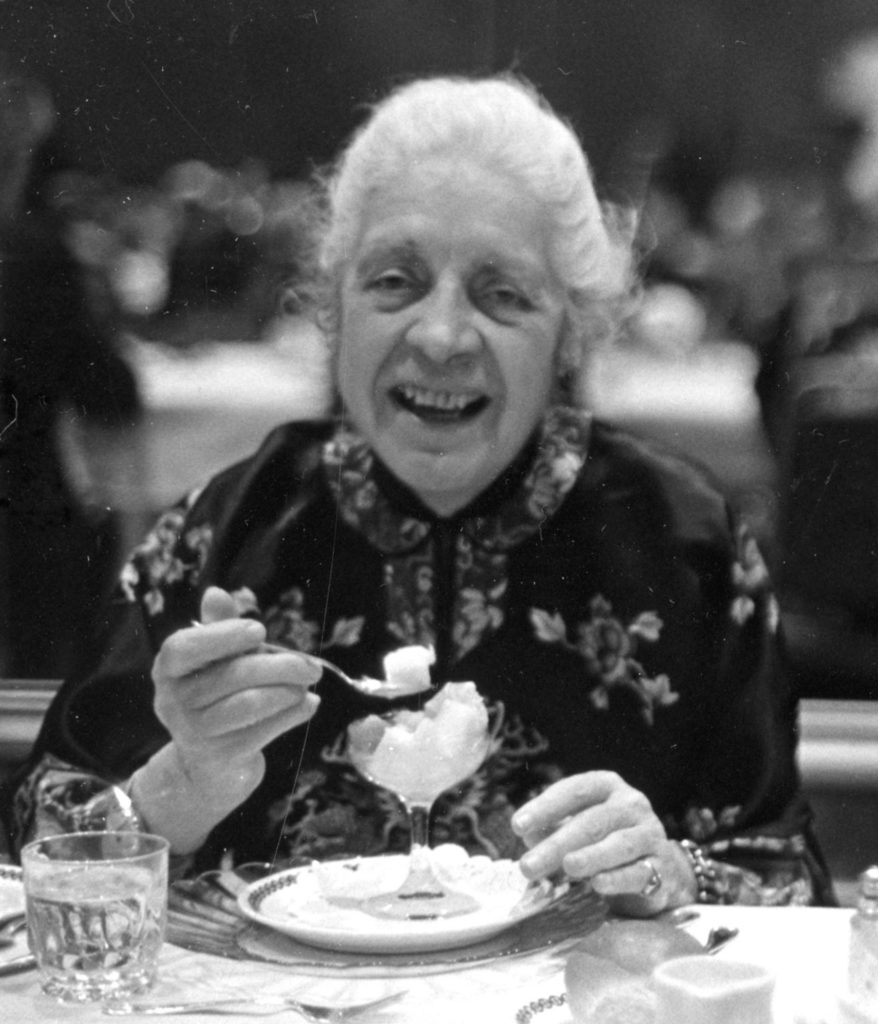
Melba Phillips Eating Ice Cream
Emilio Segrè Visual Archives
CC BY-SA 4.0, via Wikimedia Commons