One day in September 2010 during the Afghan war, I found the ancient cannon that reposes in a local park had been completely wrapped in a crocheted patchwork blanket. No identities, no explanation, only a tag “outlaw wool lovers.” An overnight prank reminiscent of a Christo stunt without the panache, the expense, or the publicity. But this silent gesture spoke volumes against war and proclaimed the power of peaceful, domestic wisdom. The local paper published a color photo, which has been on my fridge ever since. Could crochet be activism?
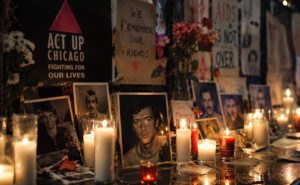
In the throes of the early AIDS crisis, people began stitching panels to remember their loved ones. The panels were joined in quilts, and the quilts were joined with each other until they became bigger than a tennis court, bigger than a football field. So unwieldy it became, the giant quilt had to be broken into pieces in order to be manipulated. Chunks would tour on display. It now has a virtual existence too and is curated by the National AIDS Memorial.
In 1989, Robert Epstein and Jeffrey Friedman made Common Threads, a 79-minute documentary, narrated by Dustin Hoffman. Based on the AIDS Memorial Quilt, their film traced the stories of five people who had died through the words of their grief-stricken friends and family. The survivors describe the solace that they had derived from quilting memorial panels for their loved ones. They also refer to milestones in the disease history: the president who would not utter the word; the movie star who acknowledged his own disease only after 15,000 had already died. The five divergent tales serve to emphasize the awesome scope of the tragedy: each panel and each name must recall an equally unique and cherished life cut short. In their final scene, the AIDS quilt lies on the Mall in Washington as names of hundreds of loved ones are read by grieving families and friends.

As the drone-less but steady camera slowly pulls back high above the patches of color in the evening light, I was reminded of the famous, expanding scene midway through, Gone with the Wind, as Scarlet O’Hara picks her way through the waste of Civil War wounded and dead. Common Threads is equally political, and it too is a love story. It won the 1989 Academy Award for Best Feature Documentary. I cannot help but imagine that the quilt and the film helped to generate the protections against discrimination of people living with HIV/AIDS provided by the Americans with Disabilities Act, signed into law in 1990.
Stitchery, knitting, embroidery, macramé and crochet have long been significant components of occupational and art therapy for mental and physical health (Leone 2021; Youngson 2019). But they have been marshalled into numerous anti-war, anti-discrimination, pro-environment causes with remarkable aplomb, talent, and humor. Remember the pink Pussyhats from the Women’s March in 2017? Patterns for them still abound on the web. The possibly antediluvian origins of crafting protest are featured in history and fiction: recall Charles Dickens’s knitters at the foot of the guillotine (Tale of Two Cities, 1859); or Margaret Atwood’s Zillah who makes art from dryer fluff, calling it “naive surrealism with a twist of feminist lemon” (Cat’s Eye, 1988); or even Peggy Erhart’s more frivolous parking-meter protest in small-town America (A Dark and Stormy Knit, 2024).
Self-described “craft nerd,” Betsy Greer coined the word “craftivism” in 2003. She wrote Knitting for Good (Roost Books, 2008) and edited an anthology that goes well beyond knitting to other techniques and contexts (Craftivism, Arsenal Pulp Press, 2014). Scholars have noticed (e.g., Moreshead and Salter, 2023; Vachhani et al, 2025). The diffuse movement has even found critics who challenge its “white, feminist appropriation of graffiti,” and seek to empower it to “evolve and become a more intersectional” practice (Close, 2018).
References
Close, Samantha. Knitting activism, knitting gender, knitting race. International Journal of Communication 12 (2018): 23-23.
Leone, Lauren. Craft in Art Therapy. Routledge, New York and London, 2021
Moreshead, Abigail, and Anastasia Salter. Knitting the in-visible: data-driven craftivism as feminist resistance. Journal of Gender Studies 32.8 (2023), 875–886.
Vachhani, Sheena J., Emma Bell, and Alexandra Bristow. The Affective Micropolitics of Craftivism: Organizing social change through the minor gesture. Organization Studies 46.4 (2025): 525-547.
Youngson, Bel. Craftivism for occupational therapists: finding our political voice. British Journal of Occupational Therapy 82.6 (2019): 383-385.
Web image by Medhum.org